If you’re here, chances are you’re a manufacturer, installer, or distributor looking to add plastic corrugated pipe production to your business—whether to expand your product line, meet rising local demand for drainage, irrigation, or construction materials, or replace outdated equipment that’s holding back output. As a plastic corrugated pipe machine supplier who’s worked with small startup teams and large-scale operations across North America, Europe, and Southeast Asia over the past 12 years, I know first-hand that choosing the right machine isn’t just about buying the most expensive model or the cheapest one off Alibaba. It’s about matching the equipment to your specific business needs, long-term goals, and even the material you’ll be working with day in and day out. Let’s break this down step by step, no confusing jargon, just real-world advice that’s helped hundreds of customers avoid costly mistakes. Plastic Corrugated Pipe Machine

First and foremost, start with what you actually plan to produce. This is the foundation of your decision, and skipping this step is the number one mistake I see new buyers make. Plastic corrugated pipes aren’t one-size-fits-all. Think about the end products your business serves. Are you making small-diameter pipes (16mm to 110mm) for residential drainage or garden irrigation? Medium pipes (110mm to 315mm) for municipal stormwater systems or agricultural field irrigation? Or large-diameter pipes (315mm to 1200mm+) for deep civil construction, highway underdrains, or large-scale industrial applications? Each size range requires a different machine: small and medium lines are compact, often with higher production speeds suited for high-volume, repetitive orders, while large-diameter lines are bulkier, require more floor space, and are built to handle heavier materials for structural use.
Beyond diameter, there’s the corrugation profile. Do you need smooth inner walls, or are you okay with corrugations on both inside and out for extra flexibility? Double-wall corrugated pipes are the most popular right now because they balance durability, weight, and cost—think of the pipes used for French drains or residential sewer lines. If you plan to work with heavy-duty materials like HDPE (high-density polyethylene) for underground applications, or flexible PVC for light-duty drainage, your machine needs to be designed to process that material correctly. Some machines are only compatible with one type of plastic, while modern lines can be adjusted to switch between HDPE, PVC, PP, and even biodegradable plastic blends if you’re looking to tap into the growing eco-friendly market. I recently worked with a customer in Texas who bought a machine designed only for PVC, then had to replace it six months later when they landed a big HDPE drainage contract—costing them twice the original investment. Don’t let that be you.
Next, factor in your production volume and capacity needs. This is tied directly to your business’s revenue goals and order volume. Are you a small business starting out with a handful of local construction clients, needing to produce 500 meters of pipe per day? Or are you a mid-sized operation with steady monthly orders for 10,000+ meters, or even a large manufacturer supplying regional distributors? Production capacity is measured in meters per hour (m/h), and standard lines range from 10 m/h for small, low-volume models up to 100 m/h or more for high-speed large-diameter lines. But don’t just look at the maximum advertised speed—ask about actual, real-world output. Some suppliers quote “theoretical maximum speed” that’s only achievable in perfect lab conditions, not when you’re working with shifts, material changes, or minor maintenance delays.
Also, consider your operating hours. If you plan to run a single 8-hour shift 5 days a week, you don’t need the same heavy-duty, 24/7 industrial line that’s built to run nonstop for 30 days straight, with robust components that can handle constant wear and tear. For a new startup, a mid-range line that can run two shifts a day is often the sweet spot—enough capacity to grow with your orders, without overinvesting in features you’ll never use.
Then there’s the critical part: quality and reliability of the machine, paired with after-sales support. A plastic corrugated pipe line is a major capital investment—costing anywhere from $15,000 for a small, entry-level model up to $200,000+ for a large, high-capacity industrial line. You can’t afford downtime. If your machine breaks down mid-production, that’s lost orders, missed deadlines, and frustrated clients. That’s why I always emphasize choosing a supplier that offers genuine, on-site support, not just a 1-800 number with long wait times.
Here’s how to vet this: First, ask for references from customers in your region who are using the same type of machine you’re considering. A supplier who’s confident in their product will give you 3 to 5 references to call, not just 1 or 2 that they pre-screened. When you call those references, ask specific questions: How often do you have breakdowns? How long does it take to get a technician on-site when you need one? Do spare parts stay in stock locally, or do you have to wait weeks for shipping from overseas? I had a customer in Ontario buy a cheap machine from a non-specialized supplier based in Asia three years ago. When the extruder motor burned out, they had to wait 21 days for a replacement part to ship, costing them a $50,000 municipal contract penalty. That’s the kind of hidden cost no one plans for.
Also, look at the quality of the core components. The extruder is the heart of the machine—if the extruder is made from low-grade steel, it will wear out quickly, leading to inconsistent pipe quality and more breakdowns. The corrugator die is another key part; a poorly designed die will create uneven corrugations, weak spots in the pipe, or waste a lot of raw material. Ask suppliers what components they use: do they use branded motors (like Siemens or ABB), gearboxes, and control systems, or generic, unbranded parts? Branded components cost a bit more upfront, but they’re tested, have reliable support, and will run for years without issues.
Automation is another factor to consider, and it’s not just a fancy perk. For small startups, a semi-automatic line might be all you need. These lines have basic controls, require a small team (2 to 3 operators per shift), and are easier to learn for new staff. But as your business grows, an automatic line can cut labor costs drastically, produce more consistent pipe quality, and reduce material waste. Automatic lines use PLC (programmable logic controller) systems that monitor and adjust production in real time—things like corrugation depth, pipe diameter, and line speed are controlled automatically, so you don’t have operators manually adjusting knobs that can lead to errors. If you plan to scale quickly, paying a bit more for a semi-automatic-to-automatic line that can be upgraded later is a smarter move than buying a fully manual line and having to replace it entirely when you grow.
Raw material waste is a big expense that many buyers overlook. A good plastic corrugated pipe machine will have built-in features to minimize offcuts and scrap. Look for lines with precision cutting systems that cut the pipe exactly to length, so you don’t have extra waste that cuts into your profit margin. Some suppliers even offer models with scrap recycling systems that grind and reprocess excess plastic, so you can reuse it instead of sending it to landfill—this not only cuts material costs but is a big selling point for customers looking for sustainable products.
Don’t forget about floor space and installation requirements. A 110mm pipe line needs about 20 to 30 meters of linear floor space, while a 600mm large-diameter line needs 50+ meters, plus space for the extruder, corrugator, haul-off unit, and cutting table. Measure your facility before you get quotes—there’s nothing worse than ordering a machine that won’t fit through your warehouse doors or take up all the floor space you need for other operations. Also, ask about installation and commissioning. Will the supplier send a technician to your site to set up the machine, test it, and train your operators on how to run it? For complex lines, this is essential—trying to run a new machine without proper training can lead to costly mistakes and damaged equipment.
Finally, factor in long-term flexibility and growth. Your business isn’t static. You might start with small-diameter PVC pipes for residential drainage, but in two years, you could land a contract for medium-diameter HDPE agricultural irrigation pipes, or even start making perforated pipes for landscaping. Ask suppliers if their machines are modular—meaning you can upgrade parts (like the corrugator die or extruder) to produce larger diameters or different materials down the line. Modular upgrades are often cheaper than buying an entirely new machine, and they let you adapt to new market demands without starting over.
At the end of the day, the right plastic corrugated pipe machine is one that aligns with your current product needs, production volume, budget, and long-term business goals. It’s not about picking the cheapest or most popular model—it’s about finding a balance between quality, support, and features that will help your business grow, not hold it back.
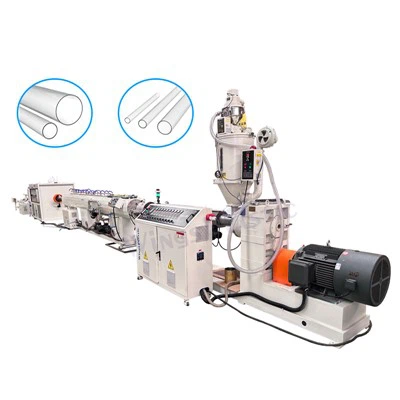
If you’re ready to get specific and compare models that fit your needs, or want to talk through challenges you’re facing, don’t hesitate to reach out for a customized consultation. We work with businesses of all sizes, from startups just getting off the ground to established operations looking to upgrade their lines, and we’ll walk you through every step—no pressure, no hidden fees.
PPR Pipe Machine References
- Plastics Pipe Institute. (2022). Technical Report on Corrugated Pipe Manufacturing and Equipment Selection. PPI Publications.
- American Society of Mechanical Engineers. (2021). Guidelines for Industrial Plastic Processing Equipment: Extrusion and Corrugation. ASME Press.
- Global Market Insights. (2023). Plastic Corrugated Pipe Market Report: Equipment Trends and Capacity Requirements. GMI Research.
Qingdao Wings Plastic Technology Co., Ltd.
As one of the most experienced plastic corrugated pipe machine manufacturers and suppliers in China, we also support customized service. Please feel free to buy durable plastic corrugated pipe machine made in China here from our factory. For price consultation, contact us.
Address: C02 Of Anshengyi Road, No.2 Fuan Industry Zone,Jiaodong Town, Jiaozhou City, Qingdao City, Shandong Province,China
E-mail: kelly@wingsplastic.com
WebSite: https://www.wingsextruder.com/
